Spring 2026
Dear posthuman studies professor,
Ever since I learned that the word “cultivate” used in agriculture means to till the land for crops, I think about it whenever I’m weeding—killing unwanted plants to remove competition for the plants I am growing intentionally. In everyday parlance, cultivation indicates nurturing and potentiality. In our first class, you encouraged us to cultivate who we are in the field we want to develop our future in. I wrote it on a post-it to remind myself of this form of cultivation. Perhaps this personal cultivation also involves eliminating or replacing some things in our life, but more so indicates a sharpening of focus—study; and connecting our pursuits to other practices, other bodies of knowledge. Over the next weeks, I will document the work done on site to create Perilla People’s Garden for the 59th Carnegie International in relation to your art history class, Reframing Nature in the Anthropocene and as a project engaging Critical Plant Studies.
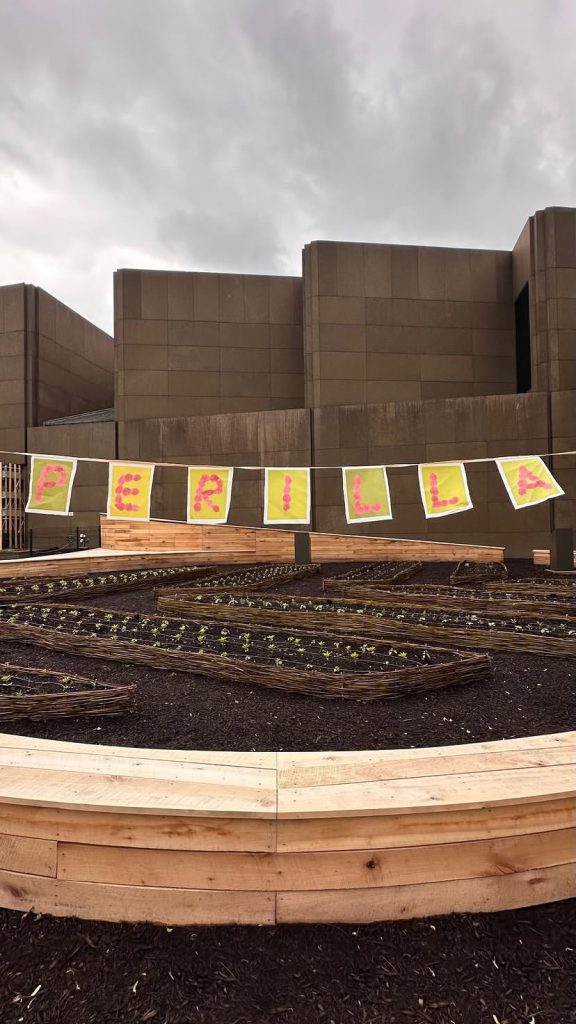
Perilla People’s Garden, installation shot by Stuart Comer, 2026
Perilla People’s Garden is located in the front of the Carnegie Museum of Art1, off of Forbes Avenue in Pittsburgh, Pennsylvania, where I have been living for the past 16 years. In May 2025, I began by doing soil tests to find out what might be present in the ground—to rule out any possible contaminants that might be hazardous to workers and visitors, as well as plant growth. I sampled the soil in twelve locations; screened it, and sent a portion off to a lab. I planted a test plot of three perilla plants and set up a wildlife camera to observe the interaction of these plants and other species on site. Rabbits, birds, and some humans were captured on video interacting with the plants, but the plants grew without being disturbed or consumed. All of the former plant matter—hydrangea, Japanese holly; hosta; viburnum, grass, thistle, and other so-called weeds—was removed from the site by a landscaping contractor and replaced with mulch. A “clean slate”, to begin a new garden. But actually, the thistle and other plants emerge again through the mulch, and I interact with them, even if it is to weed them out, there is still an acknowledgement of its tenacity, its presence, its sagacity: “The living tending of plants toward their other, the tending expressed in growth, the acquisition of nutrients, and procreation, amounts to the non-conscious intentionality of vegetal life.” (Marder, 2013) When these weeded thistles are added to a compost pile, and decompose, the nutrients held in their plant bodies join the compost, becoming next year’s amended soil.
As a mixed-race Japanese American, I was raised with a love for the flavor of shiso, and although my family moved around, we always had a garden with a spot for it to grow. Shiso’s Latin name is Perilla frutescens. Considered an irreplaceable flavor in Japanese and Korean cuisine, it is a shared plant with many names. Yet each culture claims its varieties as superior and decidedly unique from the other. Researching the presence of Perilla throughout Asia made me curious about when these cultivars were developed. Perilla seeds were found stored in clay pots in prehistoric Korea, around 1000 BC, indicating the culture’s deep historical relationship with the plant.
Perilla People’s Garden is a space where visitors can experience the wide range of plants called Perilla and learn about Japan’s occupation of Korea through the expanded context of this plant. In addition to the garden, I have created an installation inside the museum with a fragrance evoking Perilla in the context of its growing environment; a series of herbarium sheets; and an audio piece comprising interviews with farmers, botanists, and others with relationships with Perilla. Cooking workshops timed with the garden season will highlight the ways the leaves and seeds are used.
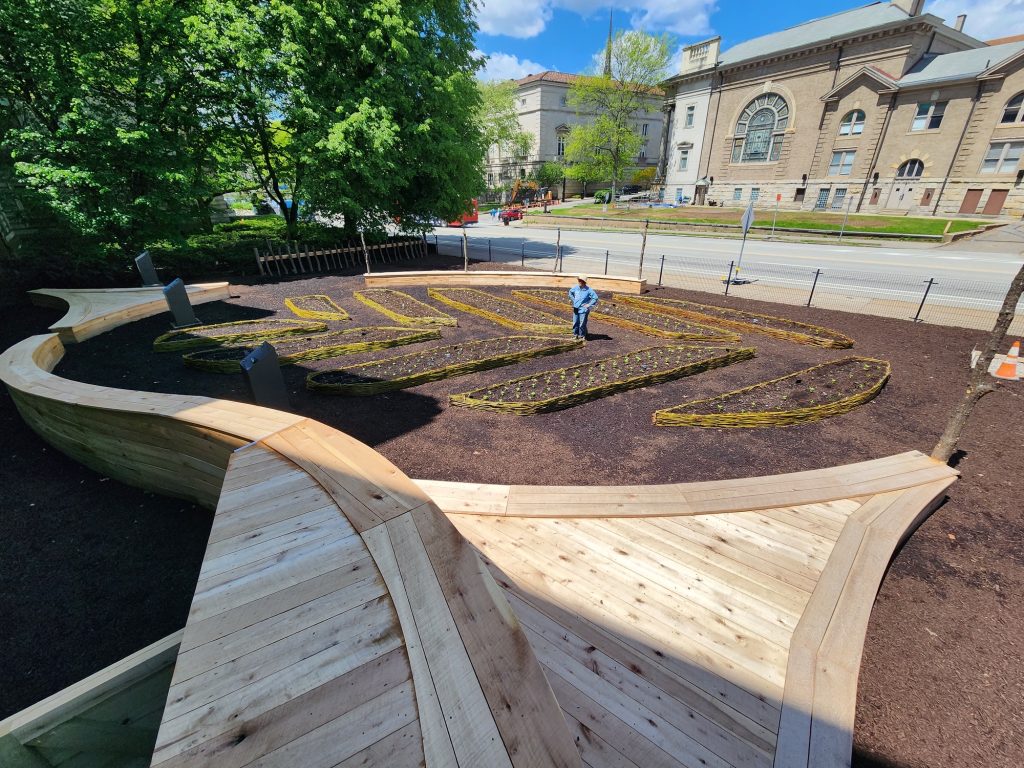
Perilla People’s Garden, installation shot by Sunni Park, 2026
The garden design was a collaborative process with exhibition designer Büro Koray Duman. Because art exhibitions are temporary, and this garden is also temporary, my aim was to use sustainable materials that can either be reused or decomposed.
Public seating that allows for real resting and facilitating human connection is a value I’ve learned by studying and creating social practice art and also through witnessing the steady increase of policing reclining bodies in public space. These garden platforms are inspired by Korean pyunsang and Pakistani charpai, seating that doesn’t dictate how one should sit or rest.
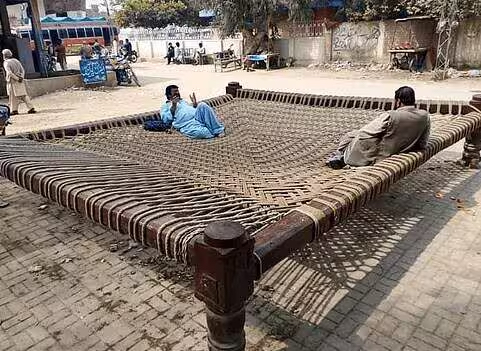
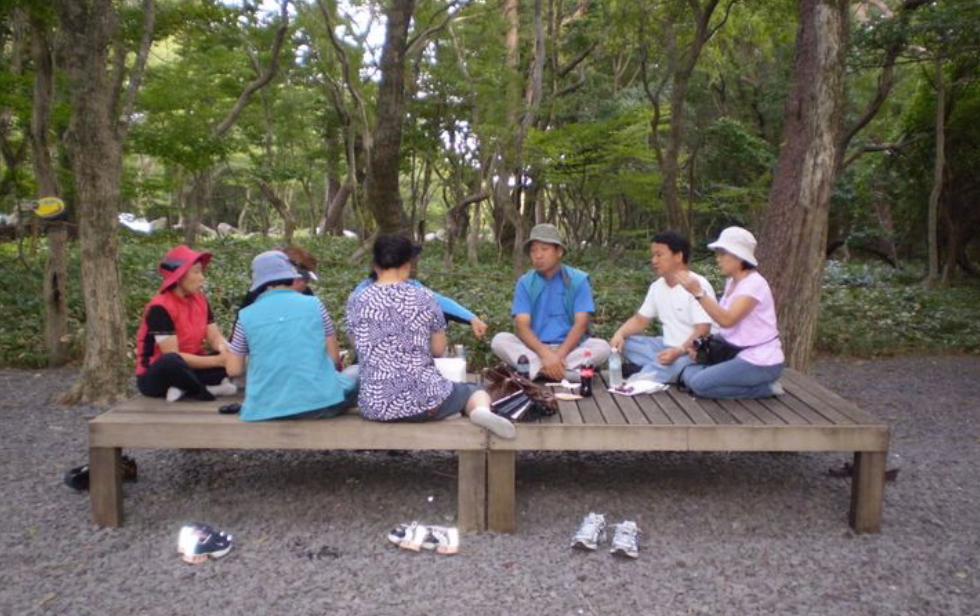
Left: Charpai in use, Pakistan; Right: Pyungsang in use, South Korea
The garden seating and structures in Perilla People’s Garden are made of green poplar, as interpreted by timber frame builders Confluence Fabrication. Using green lumber means that the wood has flexibility to create various curves in the design. Posts of oak and maple logs that were inoculated with shiitake spawn hold banners and a sun shade, and other infrastructure. I chose shiitake because it is another shared ingredient/species between Japan and Korea. In Korean, it is known as pyogo. These logs were collected last spring when a big storm came through Pittsburgh, knocking down many trees and cutting out power to many neighborhoods. After inoculating the logs, another mycelium emerged and began fruiting—Schizophyllum commune. Also known as split gill, this beautiful fungi is a kind of mascot for queer ecology. Schizophyllum has over 23,000 mating types or sexes. In The Science Underground: Mycology as Queer Discipline, Djoulakian and Kaishian explain, “Fungi show us cooperative, alternative, promiscuous, entangled, interdependent, more-than-individuated, and more-than-human modes of living worth studying, imitating, learning from, and which queerness in humans has often shared.”2
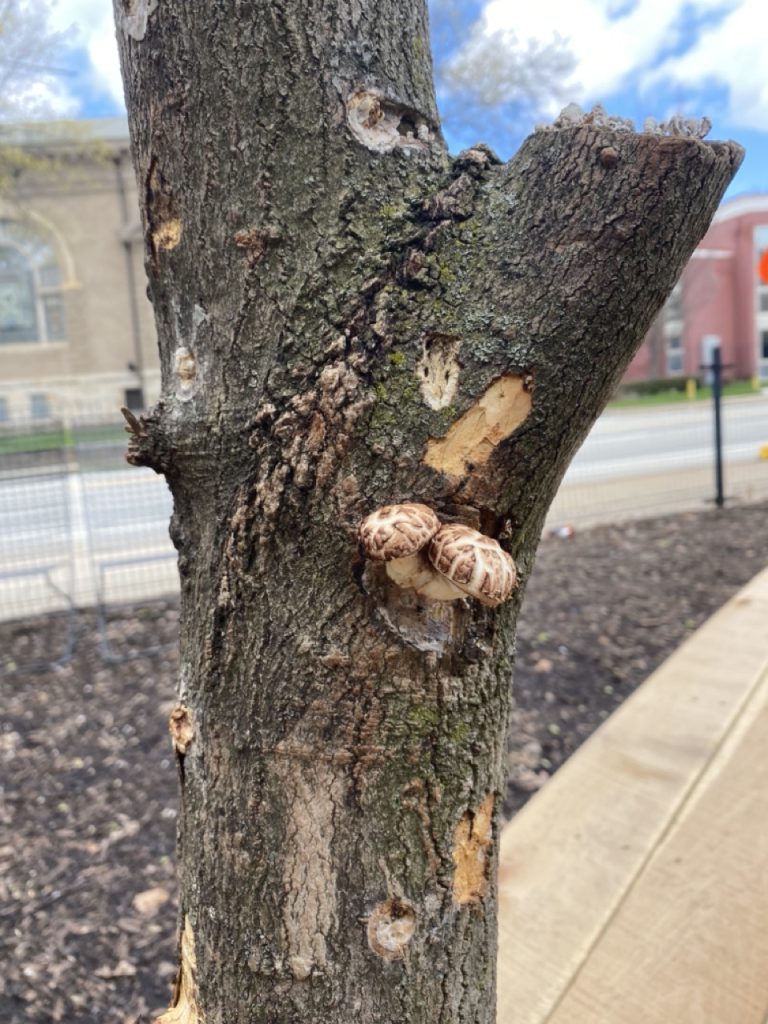
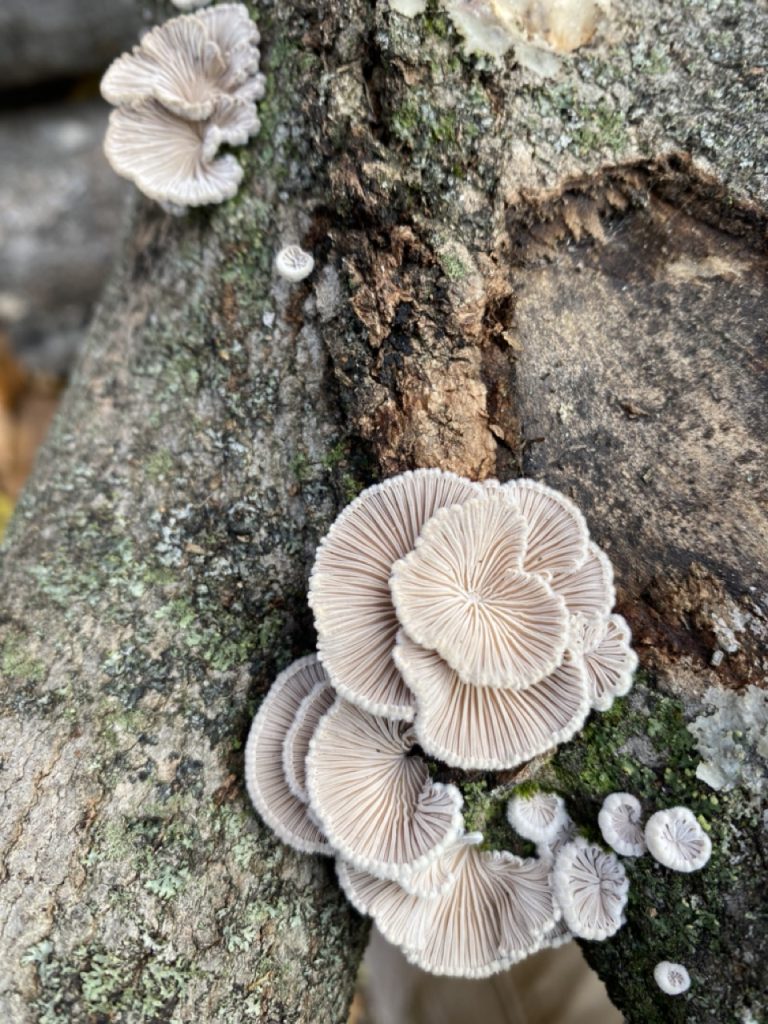
Left: Shiitake fruiting on garden posts; Right: Schizophyllum commune fruiting on inoculated shiitake logs, 2026
Schizophyllum commune and shiitake coexisting and fruiting at their own times from the same tree limbs is an example of this entanglement. In your lecture on Geography and Land Art, in reference to Beverly Buchanan’s decomposing Marsh Ruins, you also described queerness encompassing a sensitivity to land; as well as the role of decay in her work as a form of poetics. This sensitivity to place and to material can also extend to an appreciation of impermanence—In this life/death cycle of change that nature shows us is something generative. The mycelium in these posts will fruit over the duration of the exhibition and the following years, slowly decomposing the logs.
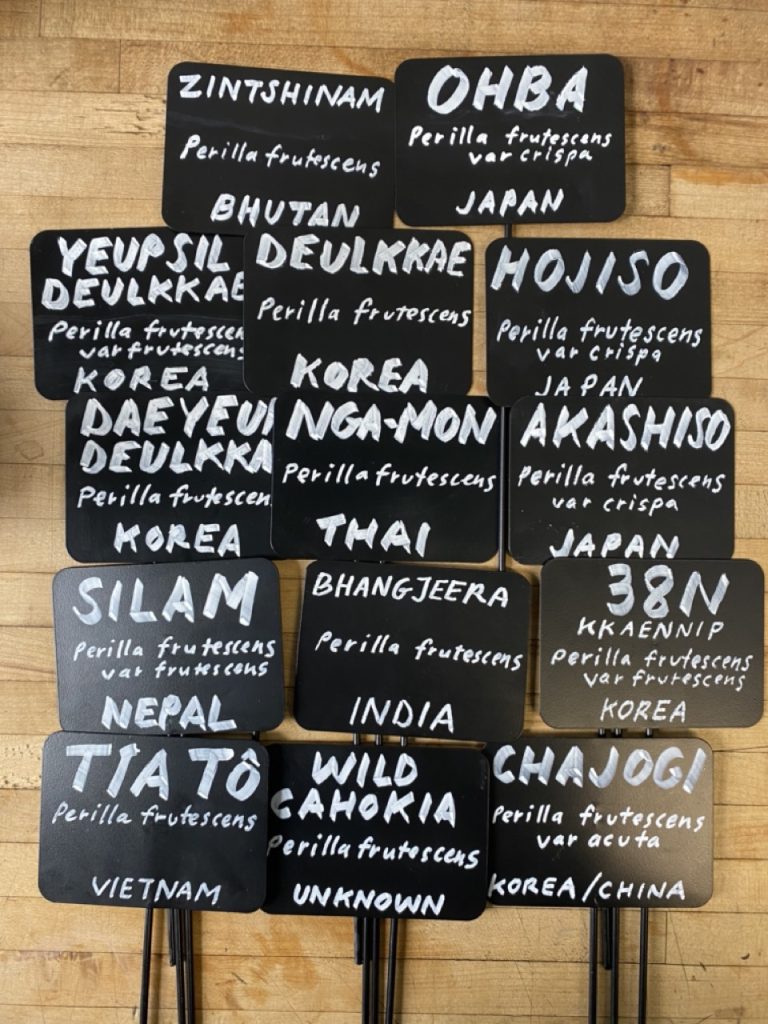
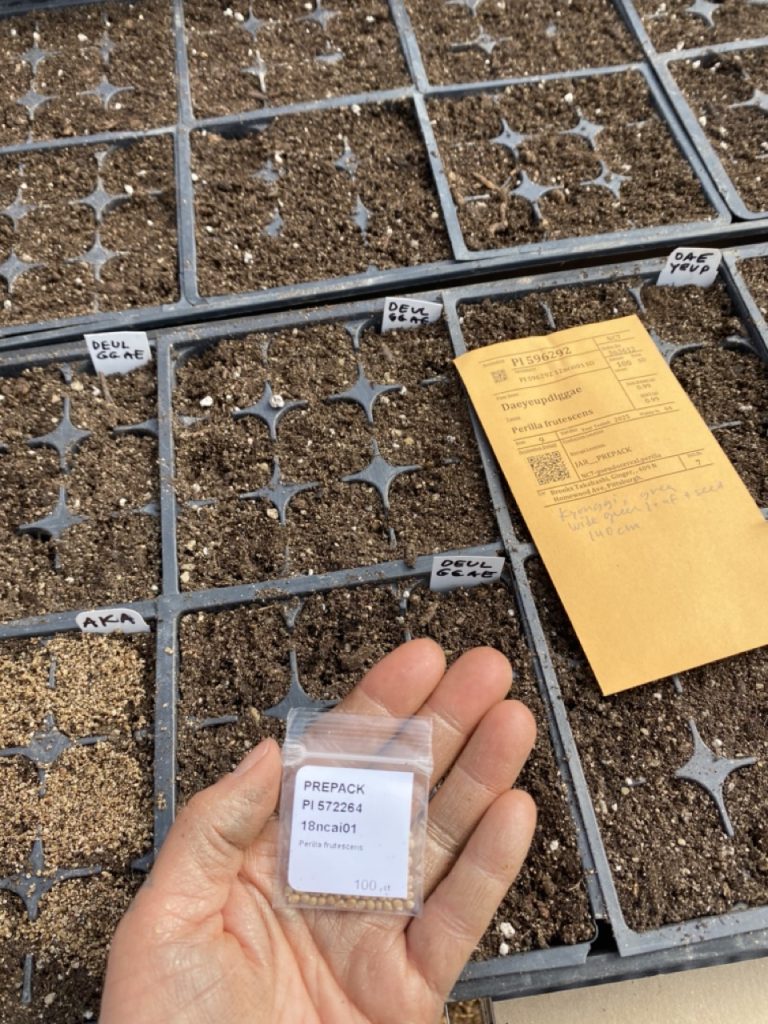
Left: plant tags; Right: Seeding in process, 2026.
In mid-March, I started seeds for the garden in my friend’s greenhouse. The plants I selected include 14 different cultivars of perilla and companion plants that act as formal punctuation and further storytelling devices in the garden. All of the plants are originally from Asia. Some are common foodstuffs like sesame and chives were additionally chosen because their physical appearance is so different from perilla and because they are well known as ingredients or products here, but often not seen growing in the fullness of a living plant.
I received a generous donation of seeds through the USDA-ARS National Plant Germplasm System, which includes varieties of perilla not commercially available in the US.3 I’m also growing Second Generation Seed’s 38N kkaennip, named after the latitude of the DMZ which is also coincidentally the same latitude as the seed farm’s original location; and Cha Jogi, which is a cultivar used in Traditional Chinese medicine. Additionally I sourced Tía tô, Vietnamese perilla and two Japanese varieties—Hojiso and Ohba/Ao Shiso from True Love Seeds in Philadelphia. In addition, I am growing Akashiso, var crispa; which I found growing on the edge of sidewalk in Pittsburgh and a wild Perilla frutescens collected by dear friend Dean Daderko from the site of Cahokia Mounds in Illinois. Below, I will detail some of the companion plants I selected for Perilla People’s Garden.
Bongseonhwa or Balsam is a flowering plant that symbolizes Korea under Japanese colonial rule. The flower’s name is also the title of a Korean resistance song that is referenced in Theresa Hak Kyung Cha’s Dictée. “My father once told me that the Japanese colonizers considered the singing of Bong Sun Hwa a gesture of defiance and, as such, sufficient grounds for arrest. I seem to recall that Korean exiles always sang the song with tears in their eyes.”4 The bright red and pink flowers are also crushed and used to paint fingernails in Korea.
Soybeans are the basis of many important sauces throughout East Asia, from fermented pastes like miso and doenjang, to soy sauces. These soybean plants in the garden act as a footnote to reference Japan’s occupation on Korea’s fermentation culture and how the Japanese government made home brewing and the wide range of fermented food practices illegal in Korea. They regulated the production of these fermented products and forced Korean producers to make them according to Japanese preferences. The impact of these new laws meant that many Korean homebrewing traditions including making fermented sauces or jang fell out of practice because they were so heavily regulated by the colonial government.
Mu/Daikon/Radish is a deeply loved root vegetable and is another shared plant in Japanese and Korean cuisine. I planted this vegetable specifically because in the US, this plant is commonly referred to by its Japanese name, Daikon, and it is important to note that it became a Japanese vegetable, as it traveled with humans from China. It is well loved throughout Asia.
Ueong/Gobo/Burdock is another beloved root vegetable shared in Korean and Japanese cuisine. Here in the US, one can find it in Asian grocery stores, and growing freely in urban soils. Maybe this is a provocative plant to add to the garden because growing uncultivated this biennial’s velcro-y seeds are considered a nuisance, and it is considered a noxious weed in some states. European settlers transported burdock to North America in the 1600s and now it is almost everywhere.
I chose to include sesame in the garden because there is misunderstanding in the translation of perilla’s Korean name. Deulkkae is translated in English as “sesame leaf.” I interviewed Japanese farmers Ken Suzuki and Ryo Kobayashi of Suzuki Farm, in Delaware about their relationships to perilla. Even though these farmers grow two varieties of shiso, and Ken Suzuki worked as a farmer for almost 50 years, neither of them knew that Korean kkaennip and shiso are related. The farmers thought that Koreans eat sesame leaves. For this reason, I planted sesame, so there would be an opportunity to bring clarity to this misnomer. Sesame plant looks very different from Perilla. The plant structure and leaves are very different, and sesame seeds grow in pods, as opposed to perilla’s flowers that turn into open pods which allow for easy self-seeding.
Because Perilla is considered an invasive species in much of the US, I created a Perilla Management Plan alongside my proposal to the museum. This was created with respect to the museum and in anticipation of the possibility that they may field complaints about hosting so-called invasive species on site.
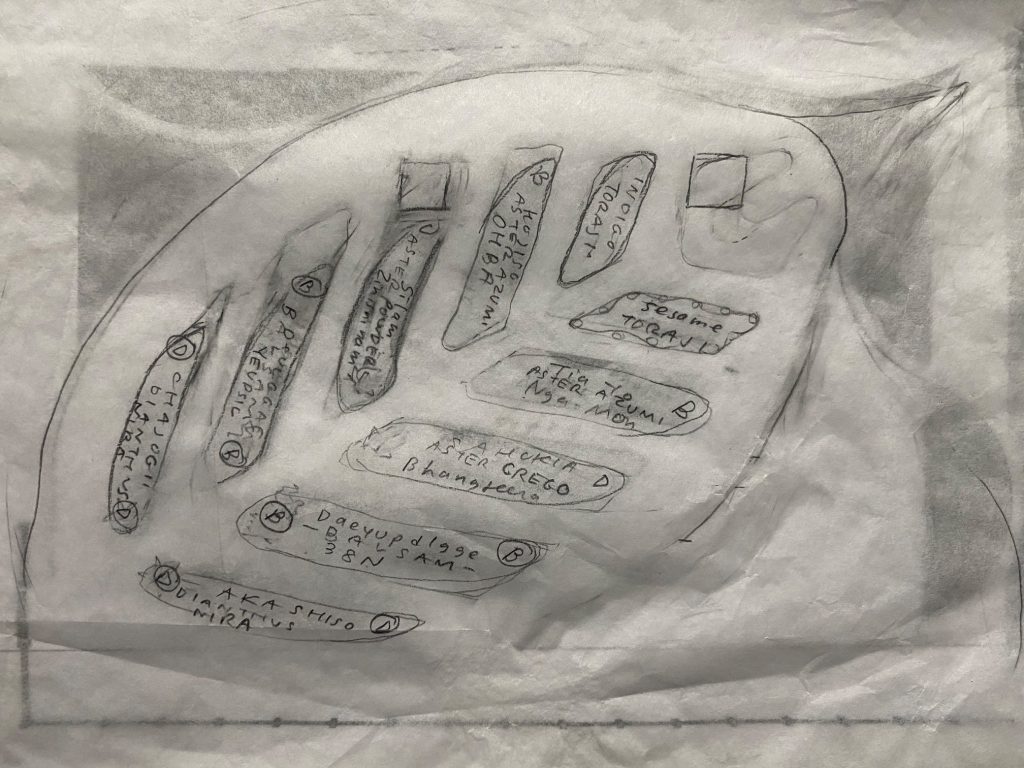
Planting diagram for Perilla People’s Garden, 2026
The garden beds are shaped like sections of a leaf, delineated with woven willow. This leaf shape design emerged from conversations in my Graduate Study Seminar last summer. Raised beds can be made with a myriad of materials, and I chose willow because I wanted to use a material with a low carbon footprint, and one that would eventually decompose. I wanted to work with a material that also had a low impact on the body—willow is lightweight and flexible, needing minimal hand tools to cut and weave with. This willow was grown at a nearby farm called Foggy Blossom. There are a few varieties of willow that the farmer grew that was long and thick enough for this work. The majority of the willow is called Rubykins or Salix koriyanagi, and is a Korean variety used in Japan and China for basketry. This felt apropos because the plant that is at the center of this artistic research, Perilla frutescens, is originally from China, and made its way with humans to Korea and Japan, established as unique cultivars in each place.
On March 28-29, I held a wattling workshop5 on site, led by Pittsburgh basketweaver Rebecca McManus. Wattling is the term for weaving willow. I organized this workshop as an opportunity for skillbuilding. Over the winter I had a private lesson with Jes Clark, another willow farmer and basketweaver and it felt like something that I could share with others through the process of weaving the garden beds. I could have wattled the beds with one basketweaver, but it felt like an opportunity to work outside of existing systems of paid labor, to expand this embodied learning activity into one of community knowledge building. As someone who has worked on farms, passing on folk traditions through shared labor can be an invaluable hands-on community event. As an artist with a background in social practice, community knowledge building is one way I expand my work to include others.
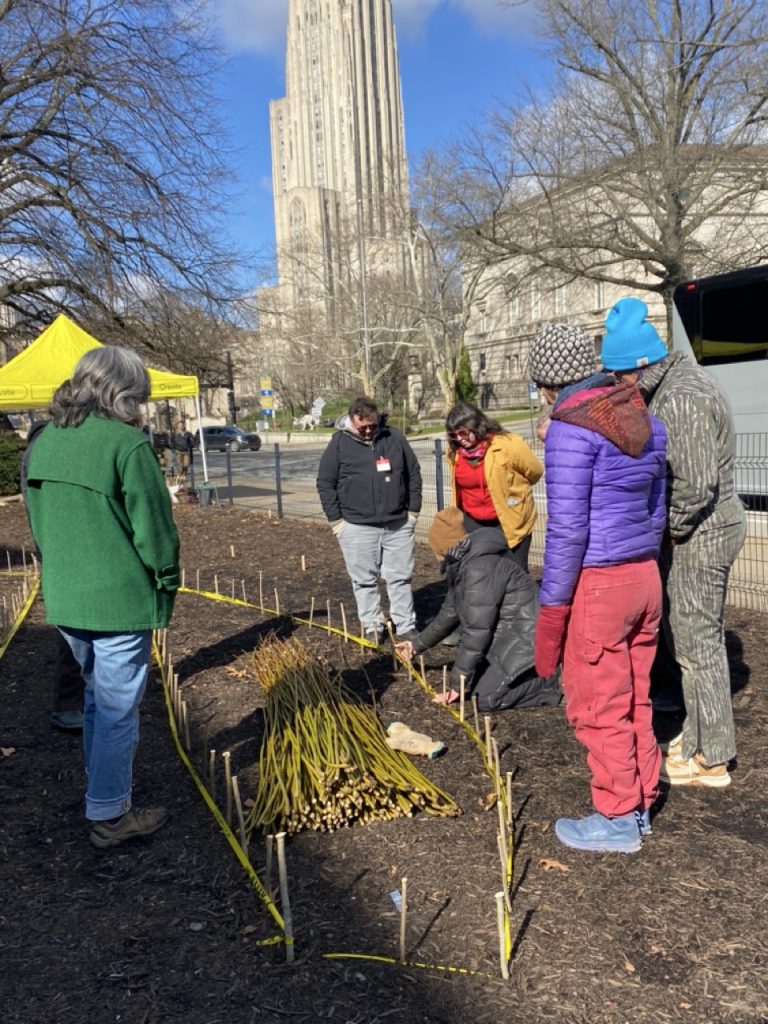
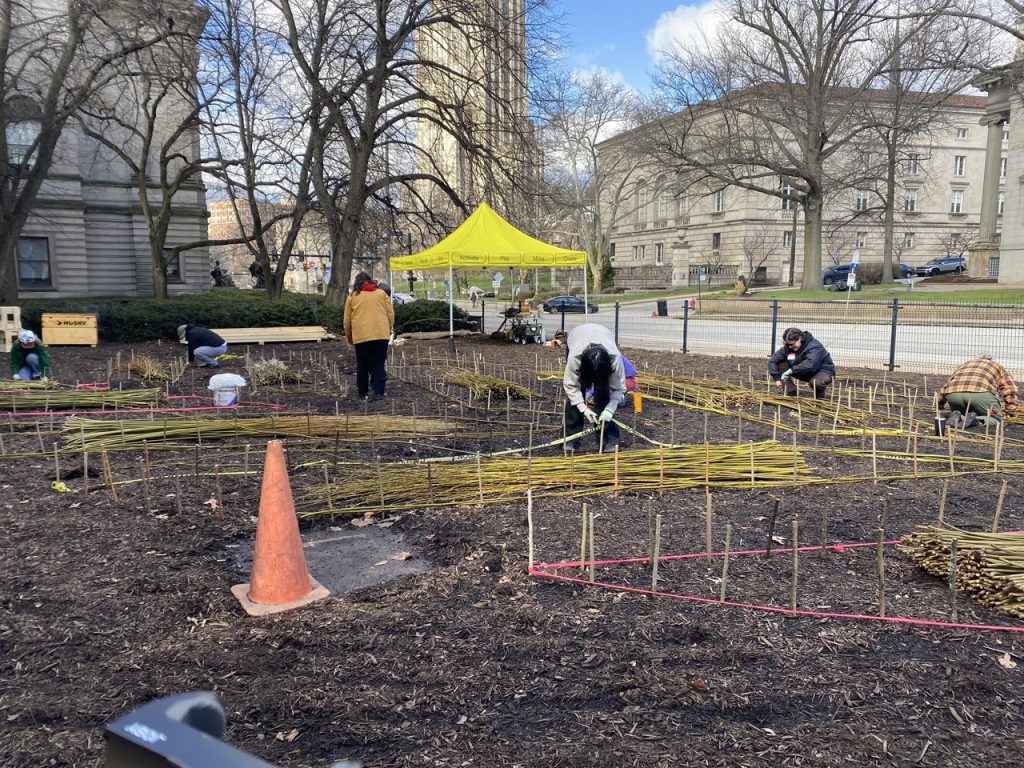
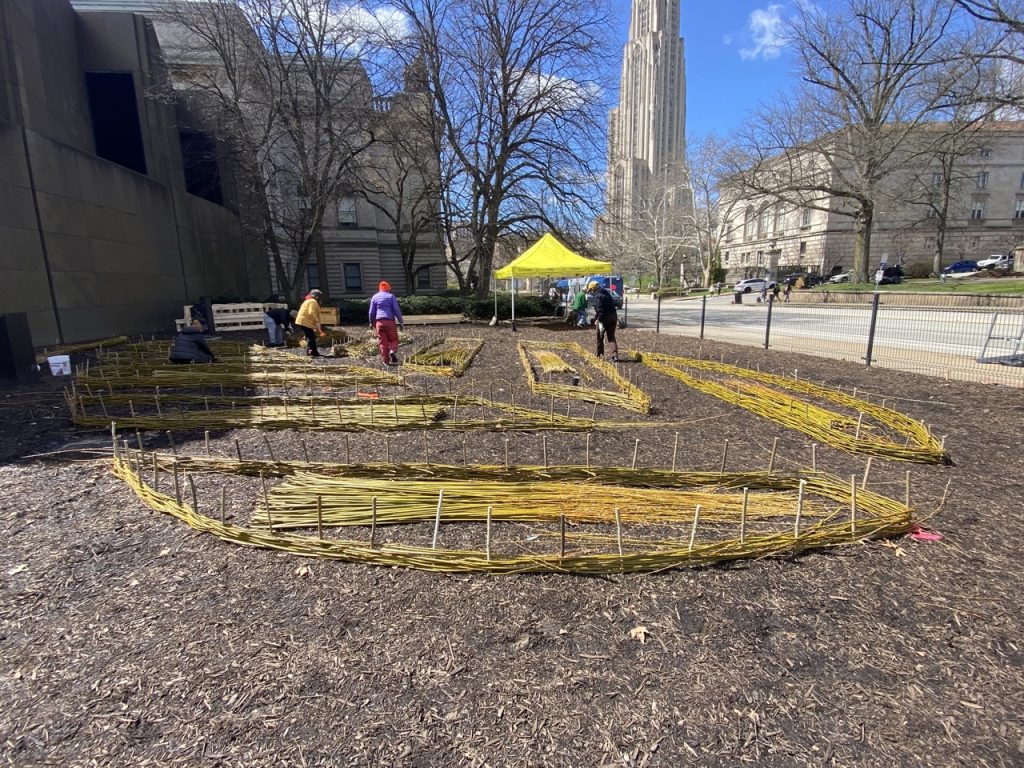
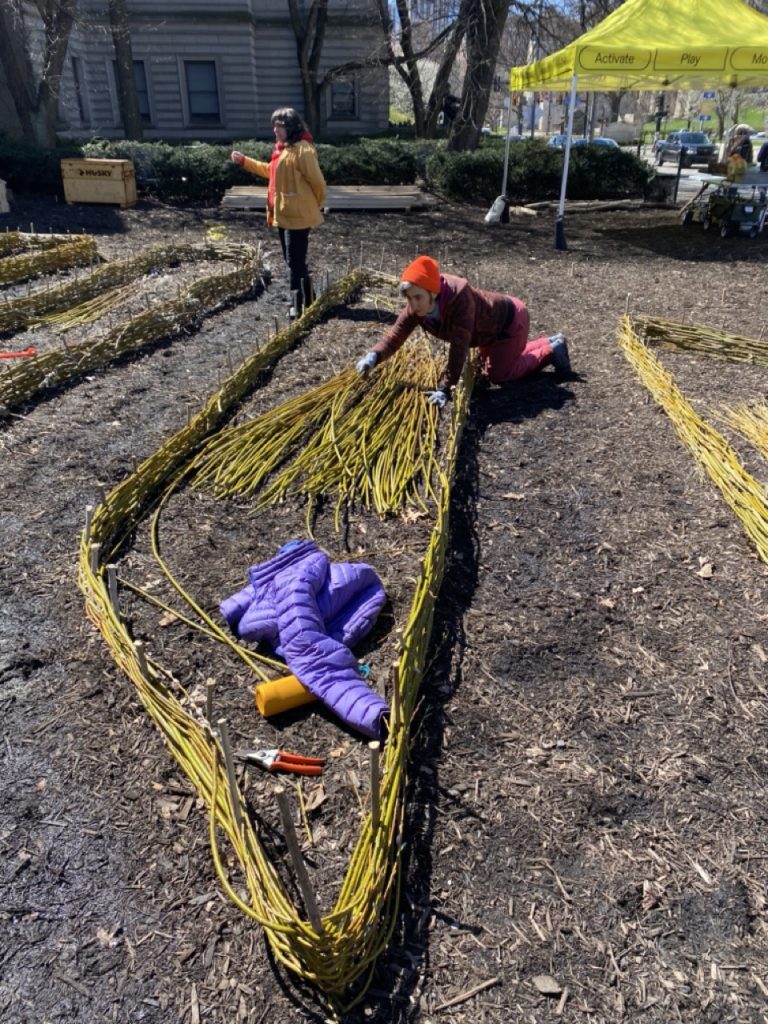
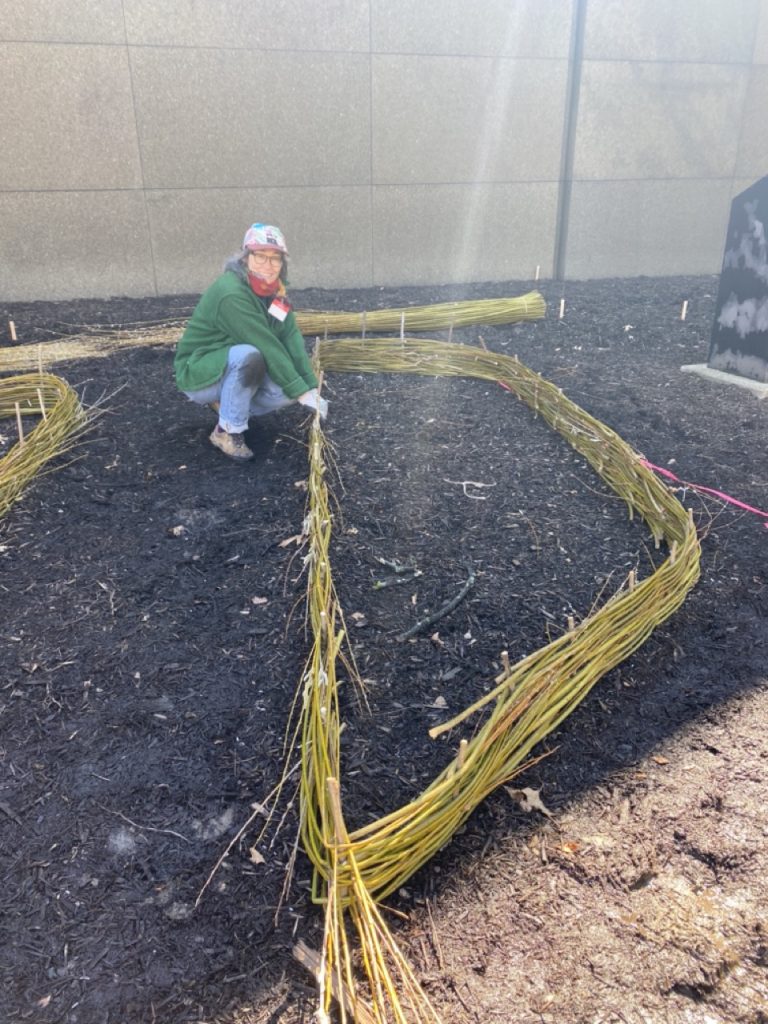
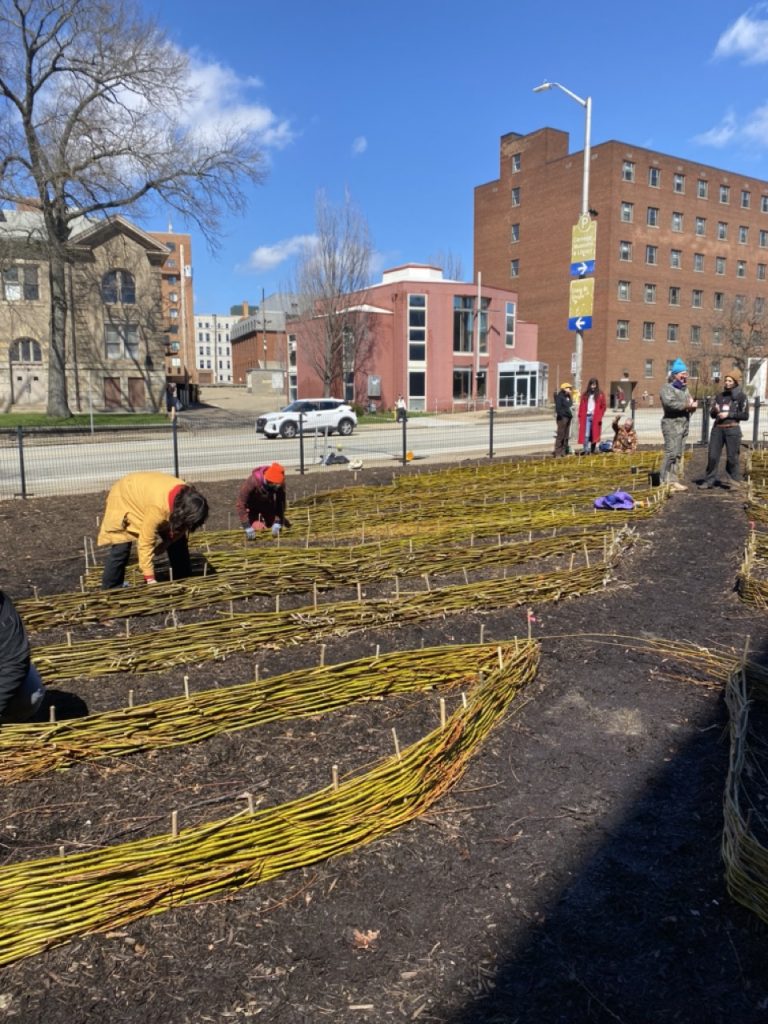
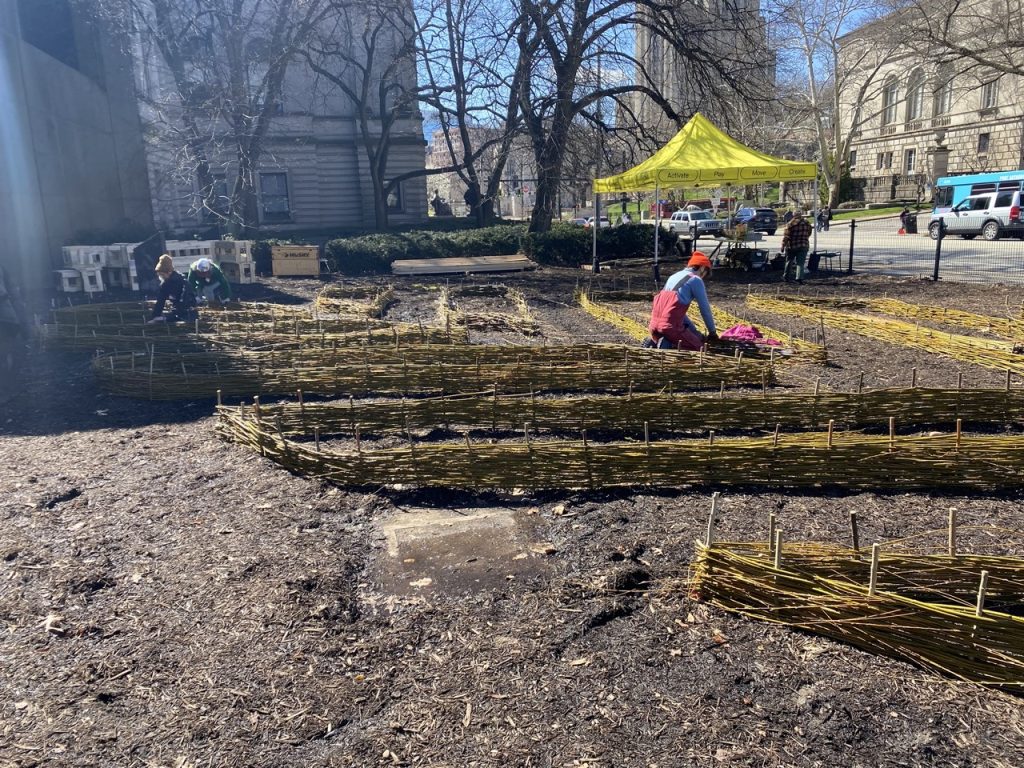
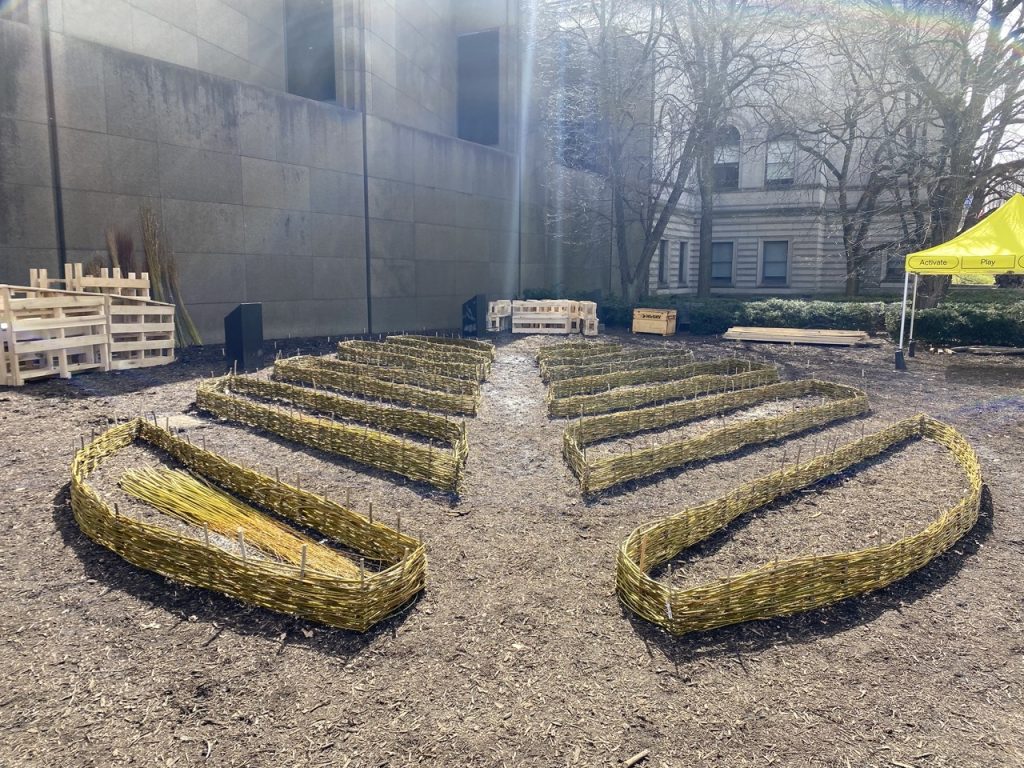
Wattling skill building workshop, photos by artist and Kell Wilkinson, 2026.
After the beds were completed, they were filled with leaf mold compost from a local municipal composting site. Nearby Edgewood borough employees collect fallen leaves and compost them in giant piles, creating a beautiful compost made available for free to residents. Time and the conditions for decomposition turn leaves which are essentially trash into something incredibly valuable—a growing medium. Two dump truck loads were delivered on the sidewalk outside the museum, as close to the garden as possible. Moving this mountain of compost became a performative ritual act. Does the physical exertion or embodied energy needed to move this giant pile of “dirt” make this material even more valuable? A team of four6 moved this compost in the course of one day using buckets, shovels, and wheelbarrows. Street trash and rocks were carefully removed. This art install labor differs from those who were hanging paintings inside the museum’s galleries, but both are ritual acts of care and devotion.
In Conclusion
Preparing for the opening of the exhibition was a little bit of a nailbiter. In Pittsburgh, we typically wait to plant until after Mother’s Day, to allow for the last frost to pass. However, the opening weekend began on May 1st, so I planned to have everything planted two weeks before. After planting we had a few early morning temperature dips into the 30s and I was prepared to cover all the plants. This made me think of Edward Steichen’s Delphinium display for MoMA in 1936. The press release starts with a Weather Permitting disclaimer—”Because of the recent cold, rainy weather, the dates given below may have to be postponed a day or two so that the delphiniums may be in full bloom.” I love this submission to nature—sometimes art has to be on plant time, instead of the other way around. So often I see art installations with plants and they are just not in their prime. They may have been planted days before and are barely alive, not yet connected to the soil they are in; or they are barely hanging on in the situation they were coaxed into. Knowing this also allowed me to be okay with having small plants. While I did start them weeks in advance, some were small when they were planted, and grew abundantly once they were in the soil. They will continue to grow throughout the summer and fall, creating a changing experience for viewers.
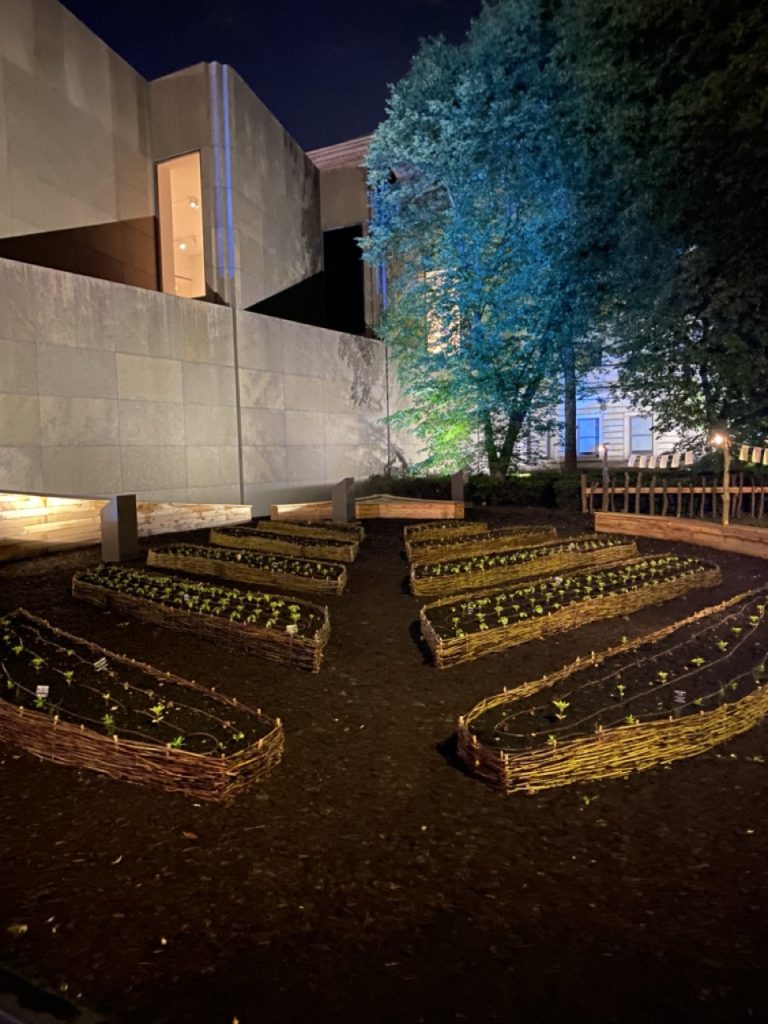
Perilla People’s Garden, Opening night, 2026
Last week when I went to weed and check on the garden, I noticed that some creatures had discovered they liked eating perilla. They seem to prefer the Cha-Jogi, as there were only four plants left of the original 15 planted. They nibbled a couple of other kkaennip plants as well, but that seemed to be the extent of the damage. I have backup plants that I have been nurturing, so I will plant those once they are a bit bigger.
I have been weeding the garden beds twice a week, and am fastidiously removing all the little plants that are emerging from the compost. I want the focus of visitors to be on the plants I am intending to grow, not on the so-called weeds. However I am curious who these freely seeding plants are. Who are the plants whose seeds got mixed in with the leaves which were collected to make this leaf mold?
I have an idea for a future work—a dumptruck load of compost set up with irrigation that is encouraged to grow freely. No weeding whatsoever. Leave everything in, including the trash, and see what emerges over the course of a growing season. Perhaps identify those plants, and present it as a portrait of a place—of us humans intertwined with all the other species. This inquiry, a physical manifestation of Puig de la Bellacasa’s care time for human-soil relations, engaging soil as an interdependent assemblage of matter, teeming with life.
Thank you for reading, and for this semester of Critical Plant Studies context.
- Previously on this site was the Lozziwurm, a tubular play structure designed by Swiss artist Yvan Pestalozzi in 1972, on display for the 2013 Carnegie International. It has since been relocated to the Children’s Museum of Pittsburgh. As I have worked on site, I have heard many young passersby lament that their playground is gone, replaced by something different. ↩︎
- Kaishian, Patricia, & Djoulakian, Hasmik (2020). The Science Underground: Mycology as a Queer Discipline. Catalyst: Feminism, Theory, Technoscience, 6(2), 1 – 26 ↩︎
- Seeds donated from the USDA-ARS National Plant Germplasm System include: Bhangjeera, Perilla frutescens, India; Silam, var frutescens, Nepal; Zintshinam, Perilla frutescens, Bhutan; Nga-mon, Perilla frutescens, Thai; Yeupsildeulkkae, var frutescens, Korea; Daeyeupdeulkkae, Perilla frutescens, Korea; and Deulggae, Perilla frutescens, Korea. ↩︎
- Kim, Elaine H. and Alarcon, Norma. Writing self, writing nation: a collection of essays on Dictée by Theresa Hak Kyung Cha. Berkeley: Third Woman Press, 1994. ↩︎
- Wattlers included: Emily Davis, Allie Levin, Kell Wilkinson, O.E. Zelmanovich, Mary Tremonte, Joey Behrens, Teresa Martuccio, Avi Rose, A. Brickman, Jenn Gooch, and curatorial assistant Michelle Song. ↩︎
- This garden install team consisted Sunni Park, Win Nunley, Ashley McBride, and myself. We all have experience working with soil. ↩︎
Bibliography
Aloi, Giovanni. Art and animals. I.B. Tauris. xvi.. 2012.
Aloi, Giovanni, and Susan McHugh, eds. Posthumanism in Art and Science : A Reader. Columbia University Press, 2022.
Aloi, Giovanni. “Weeds in Art: Growing in the Shadow of Power.” Esse Magazine, 2023.
Cha, T. H. K. (2001). Dictee (Second edition). University of California Press. https://doi.org/10.1525/9780520945333
Elliott, B. (1981). Mosaiculture: Its Origins and Significance. Garden History, 9(1), 76–98.
Gray, Ros, and Shela Sheikh. “The Wretched Earth: Botanical Conflicts and Artistic InterventionsIntroduction.” Third Text 32, nos. 2–3 (2018): 163–75. https://doi.org/10.1080/09528822.2018.1483881.
Hughes, Theodore, Jae-yong Kim, Jin-kyung Lee, and Sang-kyung Lee, eds. Rat Fire: Korean Stories from the Japanese Empire. Ithaca, NY: Cornell University Press, 2013.
Kaishian, Patricia, & Djoulakian, Hasmik (2020). The Science Underground: Mycology as a Queer Discipline. Catalyst: Feminism, Theory, Technoscience, 6(2), 1 – 26.
Kim, Roger. Fascist Flag. Purizine #1, 2021.
Kim, Roger. Korean History and Trauma in the Diaspora. Purizine #2, 2023
Kim, Elaine H. and Alarcon, Norma. Writing self, writing nation: a collection of essays on Dictée by Theresa Hak Kyung Cha. Berkeley: Third Woman Press, 1994.
Lee, Victoria. The Arts of the Microbial World: Fermentation Science in Twentieth-Century Japan, University of Chicago Press, 2021.
Li, Brian and Kim, Minkoo. (2021). Cultivation of Perilla frutescens (Lamiaceae) in prehistoric Korea. Journal of Archaeological Science: Reports 40, Part B, Article 103224.
Marder, Michael. ‘To Hear Plants Speak’ in Patricia Vieira, John Ryan, and Monica Gagliano (eds.), The Language of Plants: Science, Philosophy, and Literature (Minneapolis: University of Minnesota Press, 2017), pp. 103-125.
McKittrick, Katherine (ed) Sylvia Wynter: On Being Human as Praxis, ‘Introduction’ (Durham: Duke University Press, 2015).
Nitta, M., Lee, J. K., & Ohnishi, O. (2003). Asian PERILLA Crops and Their Weedy Forms: Their Cultivation, Utilization and Genetic Relationships. Economic Botany, 57(2), 245–253.
Bellacasa, Maria Puig de la. “Making Time for Soil: Technoscientific Futurity Pace of Care.” Social Studies of Science 45, no. 5 (2015): 691–716. http://www.jstor.org/stable/43829052.
Rhee, S. (2021). Archaeology and History of Toraijin: Human, Technological, and Cultural Flow from the Korean Peninsula to the Japanese Archipelago c. 800 BC-AD 600 (G. L. Barnes & C. M. Aikens, Eds.; 1st ed.). Archaeopress Publishing. https://doi.org/10.2307/j.ctv20rsk33